

By Jasmine Carter · Staff Writer
Published
Answer in brief
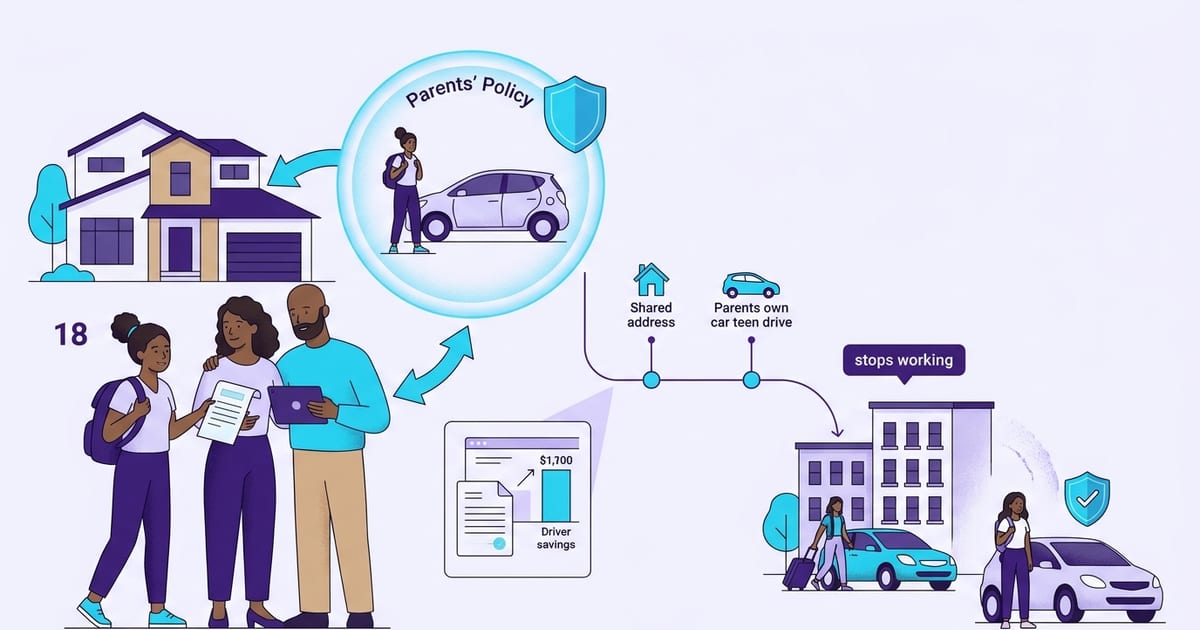
Whether you can stay on your parents' car insurance after moving out at 18 depends primarily on your vehicle's legal title and your permanent residential status. If you relocate permanently to your own apartment and the vehicle title is in your name, you must secure an independent policy. However, if your parents hold title to the car or you are only temporarily away for school, insurers frequently permit you to remain on the family policy provided the garaging address is accurately updated.
Household Residency and the Garaging Address Rule
When an 18-year-old moves out of the family home, auto insurance eligibility changes immediately. Insurance contracts are underwritten around the concept of a household member and the primary garaging address where the vehicle is parked overnight. Rating factors established by insurers include location, mileage, driving record, age, and coverage selections.
If you move into your own apartment, sign a standard annual residential lease, and establish permanent residence away from your parents, insurers consider you a separate household. At that point, attempting to stay on your parents' policy without disclosing your new address can lead to denied claims or policy rescission for failure to report accurate vehicle location details.
How Vehicle Title and Insurable Interest Dictate Coverage
The single most decisive legal hurdle when moving out is whose name appears on the vehicle title. Under insurance law, a policyholder must hold an insurable interest in the vehicle—meaning they would suffer direct financial loss if the vehicle were damaged, stolen, or destroyed. Learn more in our overview of getting your own car insurance policy at 18.
If an 18-year-old moves out and the car's title is in their sole name, parents cannot legally insure that vehicle on their policy in most jurisdictions because they no longer have an insurable interest. In that scenario, the teen must become the named insured on a standalone policy. Conversely, if the parents hold legal title or co-sign as joint owners, some insurers allow the vehicle to remain listed on the family policy even if parked at the teen's new apartment.
Permanent Move vs. Temporary Student Relocation
There is a sharp distinction between moving out permanently for independent employment and relocating temporarily for higher education. As explained in our guide to car insurance for 18-year-olds going to college, students living on campus or in temporary off-campus housing generally retain their parents' address as their permanent legal domicile.
For college students, insurers routinely keep the driver on the parent policy, though the company must still be informed if the car travels to campus. For non-students who take up permanent independent residency, no temporary student exemption exists, requiring either an updated endorsement or a newly bound separate policy.
Step-by-Step Transition to an Independent Policy
- 1
Confirm Vehicle Title Status
Check your vehicle title. If your parents are sole or joint owners, decide whether to transfer title to your name alone before applying for coverage.
- 2
Gather Documentation
Collect your driver's license number, vehicle identification number (VIN), exact new garaging address, and driving history records.
- 3
Request Quotes from Multiple Providers
According to the Insurance Information Institute, shopping at least three quotes is critical because pricing formulas differ substantially between companies.
- 4
Apply Eligible Discounts
Inquire about good student discounts, driver training credits, and telematics programs to lower initial premium costs.
- 5
Coordinate Cancellation and Effective Dates
Ensure your new policy is bound and active before your parents remove you and the vehicle from their existing coverage to avoid coverage lapses.
Managing Premiums on Your Own Policy
According to National Association of Insurance Commissioners database reports, the countrywide average expenditure for auto insurance reached $1,281 in 2023, with a combined average premium of $1,438. For an independent 18-year-old driver, standalone rates run considerably higher due to the absence of multi-car or multi-policy credits enjoyed on a parent's policy. Review comprehensive data in our breakdown of how much car insurance costs at 18.
To offset these costs, young drivers can adjust comprehensive and collision deductibles. Raising a physical damage deductible from $200 to $500 can reduce collision and comprehensive costs by 15% to 30%, while increasing it to $1,000 can save 40% or more. Pairing deductible management with car insurance discounts for 18-year-olds makes moving into an independent policy financially feasible.
Questions & answers
Can I stay on my parents' insurance if I rent an apartment in the same town at 18?
If you rent an apartment permanently, you are considered a separate household. If the car is titled to you, you must buy your own policy. If the vehicle is titled to your parents, some insurers will allow it to stay on the family policy if the new garaging address is formally endorsed on the policy.
What happens if I don't tell the insurer that I moved out at 18?
Failing to update your garaging address is a misrepresentation of underwriting risk. If you file a claim after a crash or theft at your new address, the insurer may investigate, deny the claim, and cancel the policy.
Is it cheaper to stay on my parents' insurance or get my own policy at 18?
Staying on a parents' policy is almost always substantially cheaper because family policies benefit from bundled multi-car discounts, mature driver rating credits, and shared account longevity.
Can an 18-year-old get their own policy if the car is titled in a parent's name?
In most states, an insurer will not issue a primary standalone policy to an 18-year-old if the vehicle title belongs exclusively to the parent, because the driver lacks formal insurable interest. The title must typically include the young driver's name.
Terms: Garaging address, Household member, Named insured, Premium, Deductible
Sources and references
Legal figures on this page (minimum limits, filing periods, statutory benefits) are checked against the primary law or the state insurance regulator listed below. Links and figures last verified Nov 2026.
- Teenagers — Insurance Institute for Highway SafetyIndependent researchTeen crash risk, graduated driver licensing research and vehicle recommendations for young drivers.
- Graduated licensing laws by state — Insurance Institute for Highway SafetyIndependent researchState-by-state learner, intermediate and full-licence ages, night-driving and passenger restrictions.
- 2019–2023 Auto Insurance Database: average premium supplement — National Association of Insurance Commissioners (2025)Statistical dataCountrywide average expenditure $1,281 in 2023 (+13.98%); combined average premium $1,438; state tables for liability, collision and comprehensive.
- Fatality facts: Teenagers — Insurance Institute for Highway Safety (2024)Statistical dataFatal crash rate per mile driven for 16–19-year-olds is just over 3 times the rate for drivers 20 and older (2022 travel data); all-severity crash rate is over 4 times; risk is highest at 16–17.
- Auto insurance for teen drivers — Insurance Information InstituteConsumer guidanceAdding a teen to a parent's policy versus a separate policy; good-student and driver-training discounts; vehicle choice.
- What determines the price of an auto insurance policy? — Insurance Information InstituteConsumer guidanceRating factors: driving record, mileage, location, age, gender, vehicle, credit-based insurance score, coverage choices. Notes ZIP-code rating is prohibited in California and Michigan and gender rating is prohibited in seven states.
- Nine ways to lower your auto insurance costs — Insurance Information InstituteConsumer guidanceShop at least three quotes; raising a deductible from $200 to $500 can cut collision/comprehensive cost 15–30%, $1,000 can save 40%+; drop physical damage on cars worth under 10× the premium; bundling, low-mileage and good-student discounts.
- Consumer insurance information — National Association of Insurance CommissionersConsumer guidancePlain-language guides from the body of state insurance regulators; links to every state's insurance department and complaint process.
Practical guidance on this page is original editorial work. Cited sources support factual statements and do not endorse this site. Dollar ranges described as typical or illustrative are editorial estimates, not figures from these sources.