

By Tyler Brooks · Editor
Published · Updated
Answer in brief
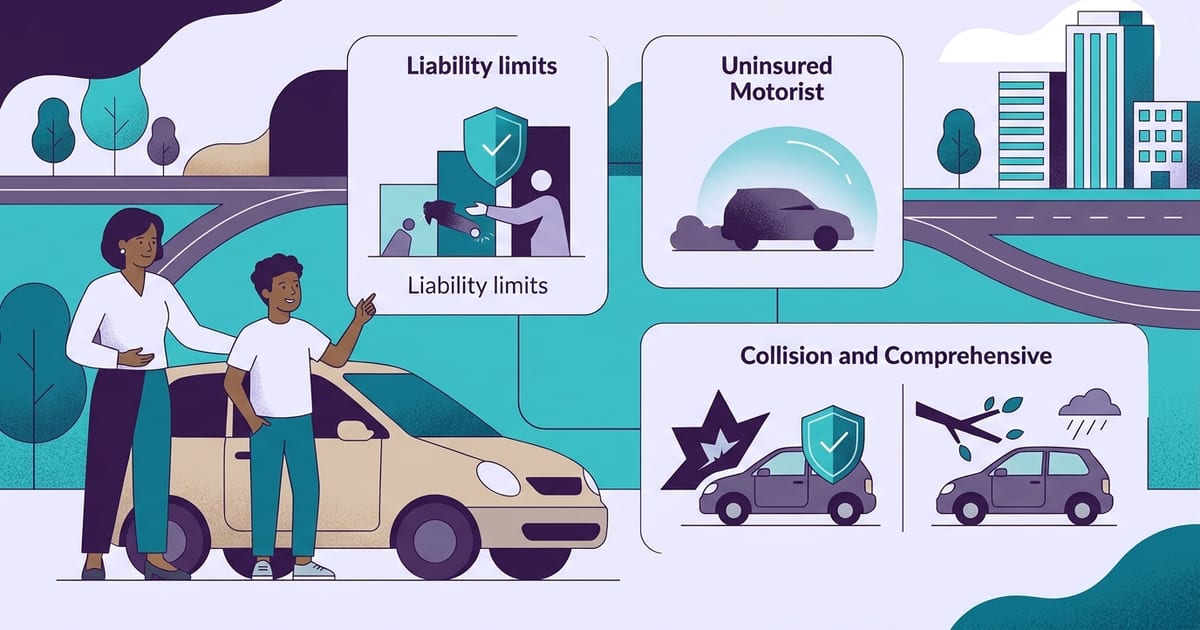
An 18-year-old has above-average crash risk, which makes liability limits the priority—50/100/50 at minimum, 100/300/100 if affordable—because a serious at-fault crash at state-minimum limits leaves the driver (and sometimes the household) personally liable. Add uninsured motorist at the same limits. Carry collision and comprehensive if the car is financed or worth more than about $5,000, with a $1,000 deductible; on an older owned car, liability plus comprehensive is often the right trade.
Why not the minimum
Raising liability from a 25/50/25 minimum to 100/300/100 adds perhaps 10–20% to the liability portion. A single injury claim can exceed $25,000 with one hospital stay. The expected cost of being underinsured is far higher than the premium saved.
Collision and comprehensive
Required by lenders. On an owned car, compare the car's value with the annual cost of these coverages plus the deductible; if the coverages cost 10% or more of the value, drop collision and consider keeping comprehensive alone. The cars guide explains how vehicle choice drives this cost.
What to skip
Low deductibles (they cost more than they return), gap insurance unless the car is financed with little down, and add-ons you will not use. Spend the money on liability limits instead.
Entries in this guide
Specific questions answered in more depth.
Entry
When to Drop Collision and Comprehensive Coverage at 18
Learn when dropping collision and comprehensive coverage at 18 makes financial sense, how the 10x premium rule works, and how to evaluate deductible choices.
Entry
Why 18-Year-Olds Need Uninsured Motorist Coverage
Learn why uninsured motorist coverage is essential for 18-year-old drivers, what state data shows about uninsured rates, and how to verify your limits.
Questions & answers
Should an 18-year-old have full coverage?
If the car is financed, yes. If owned and worth more than about $5,000, usually yes with a $1,000 deductible.
Is state minimum liability enough at 18?
No. A single injury claim can exceed minimum limits and leave you personally liable.
Do I need uninsured motorist coverage?
It is required in many states and recommended everywhere; match it to your liability limits.
Terms used in this guide
- Liability limits
- The maximum your policy pays for injuries and damage you cause, e.g. 100/300/100 in thousands.
- Uninsured/underinsured motorist coverage
- Pays for your injuries when the at-fault driver has no or too little insurance.
- Deductible
- What you pay before collision or comprehensive pays. $1,000 is the usual choice for young drivers who can cover it.
- Full coverage
- Liability plus collision and comprehensive.
Sources and references
Legal figures on this page (minimum limits, filing periods, statutory benefits) are checked against the primary law or the state insurance regulator listed below. Links and figures last verified Nov 2026.
- Teenagers — Insurance Institute for Highway SafetyIndependent researchTeen crash risk, graduated driver licensing research and vehicle recommendations for young drivers.
- Graduated licensing laws by state — Insurance Institute for Highway SafetyIndependent researchState-by-state learner, intermediate and full-licence ages, night-driving and passenger restrictions.
- Facts + Statistics: Uninsured motorists — Insurance Information Institute (2024)Statistical dataInsurance Research Council estimates of uninsured drivers by state (2022: e.g. Michigan 19.6%, California 17.0%, Florida 15.9%, Texas 13.8%).
- Automobile financial responsibility limits by state — Insurance Information Institute (2023)Statistical dataCompulsory coverages and minimum liability limits by state (table dated December 2023 — several states have raised limits since; see statute entries).
- Fatality facts: Teenagers — Insurance Institute for Highway Safety (2024)Statistical dataFatal crash rate per mile driven for 16–19-year-olds is just over 3 times the rate for drivers 20 and older (2022 travel data); all-severity crash rate is over 4 times; risk is highest at 16–17.
- What is covered by a basic auto insurance policy? — Insurance Information InstituteConsumer guidanceDefines bodily injury and property damage liability, MedPay, PIP, uninsured/underinsured motorist, collision, comprehensive and glass coverage.
- How much auto coverage do I need? — Insurance Information InstituteConsumer guidanceWhy state minimums are a floor; choosing liability limits that protect assets; when collision and comprehensive are worth keeping.
- Is it legal to drive without insurance? — Insurance Information InstituteConsumer guidanceEvery state requires drivers to demonstrate financial responsibility; in most states insurance is the mandatory way to do so.
Practical guidance on this page is original editorial work. Cited sources support factual statements and do not endorse this site. Dollar ranges described as typical or illustrative are editorial estimates, not figures from these sources.
Guide
Getting Your Own Car Insurance Policy at 18
How an 18-year-old buys a policy independently: legal capacity, documents needed, coverage to choose, payment plans, and how to keep the price down.
Guide
Best Cars to Insure at 18
Which cars are cheap and expensive to insure for an 18-year-old—size, horsepower, safety ratings, repair cost, theft—and how to check before buying.
Guide
How to Compare Car Insurance at 18
A comparison method for 18-year-olds: fixed coverage, identical inputs, every discount mentioned, four or more quotes, and the questions that reveal how an insurer treats young drivers.