

By Tyler Brooks · Editor
Published
Answer in brief
Uninsured and underinsured motorist coverage protects an 18-year-old driver if an at-fault motorist carries no insurance or lacks sufficient limits to pay for medical care and vehicle repairs. Because young drivers face elevated crash rates and more than one in five motorists drive without insurance in several states, carrying this protection prevents catastrophic out-of-pocket costs. Adding or matching this coverage to your bodily injury liability limit is one of the most effective safety nets available when buying or updating a policy.
What Uninsured and Underinsured Motorist Coverage Protects
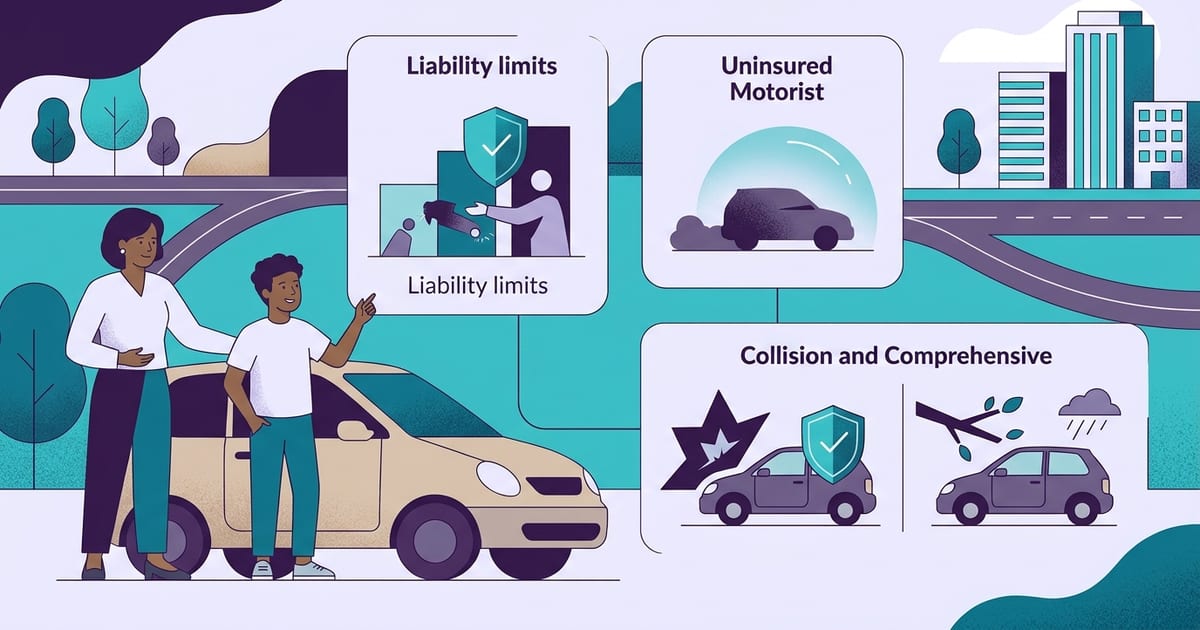
When you purchase car insurance for 18-year-olds, state law mandates that you carry liability protection to pay for damage and injuries you cause to other people. However, standard liability insurance pays nothing toward your own injuries or vehicle repairs when another driver crashes into you. For that protection, drivers rely on uninsured motorist coverage (UM) and underinsured motorist coverage (UIM).
Uninsured motorist bodily injury pays for hospital bills, rehabilitation, and lost earnings when an at-fault driver has no auto policy or flees the scene in a hit-and-run incident. Underinsured motorist coverage activates when the at-fault driver has active insurance, but their state-mandated liability limits are exhausted before all of your medical bills are settled. In some jurisdictions, uninsured motorist property damage also covers vehicle repair costs if you do not carry separate collision coverage.
| State or Jurisdiction | Estimated Uninsured Driver Rate |
|---|---|
| Mississippi | 28.2% |
| New Mexico | 24.1% |
| District of Columbia | 23.1% |
| Michigan | 22.3% |
| Florida | 20.6% |
| California | 20.4% |
| Texas | 14.5% |
| Maine (lowest nationally) | 5.7% |
Why Crash Exposure Makes UM/UIM Critical at 18
Young drivers carry a statistically distinct risk profile on American roadways. According to data from the Insurance Institute for Highway Safety, the fatal crash rate per mile driven for 16-to-19-year-olds is just over 3 times the rate for drivers 20 and older, and their all-severity crash rate is over 4 times higher. Furthermore, fatal-crash involvement per 100,000 licensed drivers reaches 42.40 for drivers aged 16 to 20, compared to 35.34 for ages 21 to 24, 28.97 for ages 25 to 34, and 24.18 for ages 35 to 44.
Because 18-year-olds spend more time driving during nighttime hours, commuting to entry-level jobs, or navigating congested campus corridors, their cumulative exposure to other motorists is substantial. If an uninsured driver strikes an 18-year-old, the young driver cannot rely on the other driver's policy to settle medical debts. Without UM/UIM on either an own policy or a parents' policy, the injured teen and their family face direct financial responsibility for those expenses.
How Uninsured Motorist Limits Should Be Structured
When insurers write a policy, they typically permit you to purchase UM and UIM limits up to the amount of bodily injury liability you carry for yourself. For example, if you carry higher liability limits to shield household earnings and assets, your uninsured motorist coverage should be set at that exact same amount. Opting out of UM coverage or dropping it down to statutory minimums leaves a severe gap in protection while saving only an illustrative $50 to $150 per year on an annual premium.
- 1
Examine Your Current Declarations Page
Locate the lines labeled Uninsured Motorist Bodily Injury (UMBI) and Underinsured Motorist Bodily Injury (UIMBI) on your existing policy documents.
- 2
Verify Limit Alignment
Ensure your UMBI and UIMBI limits match your primary bodily injury liability limits rather than state minimum amounts.
- 3
Review Property Damage Options
If you drive an older vehicle without collision coverage, check whether your state allows Uninsured Motorist Property Damage (UMPD) to cover repairs if an uninsured driver hits you.
- 4
Obtain Written Quote Comparisons
Use an online comparison workflow to request quotes from multiple insurers that explicitly include matched UM/UIM limits before binding.
Coverage on a Parents' Policy vs. an Independent Policy
If an 18-year-old remains listed as a household member on a family policy, they generally share the UM/UIM limits established by the primary named insured. This arrangement provides superior protection at a fraction of the cost because family policies typically maintain higher underlying liability ceilings than an 18-year-old would choose on a standalone policy.
Conversely, an 18-year-old establishing an independent policy must actively verify that UM/UIM is selected during application setup. Some states allow drivers to sign a rejection form waiving uninsured motorist coverage. Rejecting this protection to save a minimal amount on the initial down payment is rarely advisable given that uninsured motorist rates exceed 20% in multiple major jurisdictions. You can explore complete coverage combinations in our guide to what coverage an 18-year-old needs.
Questions & answers
Is uninsured motorist coverage mandatory for 18-year-old drivers?
In several states, uninsured motorist coverage is compulsory by law. In others, insurers are required to offer it, but policyholders may reject it in writing. Because 18-year-olds face elevated crash risks, maintaining this coverage is strongly recommended even where optional.
Does uninsured motorist coverage pay if the other driver flees the scene?
Yes. In most states, a hit-and-run crash where the at-fault motorist cannot be identified is treated as an uninsured motorist bodily injury claim, provided an official crash report is filed in accordance with policy terms.
How much does adding uninsured motorist coverage cost an 18-year-old?
Adding UM/UIM coverage is relatively inexpensive compared to liability or collision coverage, typically accounting for an illustrative 5% to 10% of total policy premium while protecting against massive medical expenses.
Can an 18-year-old collect UM benefits if injured as a passenger or pedestrian?
Yes. Standard uninsured motorist bodily injury coverage protects the named insured and resident relatives if they are injured by an uninsured motorist while riding as a passenger in someone else's car or while walking as a pedestrian.
Terms: Uninsured/underinsured motorist coverage, Liability limits, Collision coverage, Premium, Household member
Sources and references
Legal figures on this page (minimum limits, filing periods, statutory benefits) are checked against the primary law or the state insurance regulator listed below. Links and figures last verified Nov 2026.
- 14 percent of U.S. drivers were uninsured in 2022 — Insurance Research Council (2023)Independent researchAbout one in seven drivers was uninsured in 2022; highest D.C. 25.2%, New Mexico 24.9%, Mississippi 22.2%; lowest Wyoming 5.9%, Maine 6.2%, Idaho 6.2%. Method: ratio of UM to BI claim frequencies.
- Estimated percentage of uninsured motorists by state, 2017–2023 — Insurance Information Institute (2025)Statistical dataIRC time series by state; 2023: Mississippi 28.2%, New Mexico 24.1%, D.C. 23.1%, Michigan 22.3%, Florida 20.6%, California 20.4%, Texas 14.5%; lowest Maine 5.7%.
- Fatality facts: Teenagers — Insurance Institute for Highway Safety (2024)Statistical dataFatal crash rate per mile driven for 16–19-year-olds is just over 3 times the rate for drivers 20 and older (2022 travel data); all-severity crash rate is over 4 times; risk is highest at 16–17.
- Drivers in fatal motor vehicle crashes by age, 2023 — Insurance Information Institute (2025)Statistical dataFatal-crash involvement per 100,000 licensed drivers: 42.40 (16–20), 35.34 (21–24), 28.97 (25–34), 24.18 (35–44), 21.70 (45–54), 19.45 (55–64), 15.44 (65–74), 16.63 (75+).
- Automobile financial responsibility limits by state — Insurance Information Institute (2023)Statistical dataCompulsory coverages and minimum liability limits by state (table dated December 2023 — several states have raised limits since; see statute entries).
- What is covered by a basic auto insurance policy? — Insurance Information InstituteConsumer guidanceDefines bodily injury and property damage liability, MedPay, PIP, uninsured/underinsured motorist, collision, comprehensive and glass coverage.
- How much auto coverage do I need? — Insurance Information InstituteConsumer guidanceWhy state minimums are a floor; choosing liability limits that protect assets; when collision and comprehensive are worth keeping.
- Is it legal to drive without insurance? — Insurance Information InstituteConsumer guidanceEvery state requires drivers to demonstrate financial responsibility; in most states insurance is the mandatory way to do so.
Practical guidance on this page is original editorial work. Cited sources support factual statements and do not endorse this site. Dollar ranges described as typical or illustrative are editorial estimates, not figures from these sources.
Entry
When to Drop Collision and Comprehensive Coverage at 18
Learn when dropping collision and comprehensive coverage at 18 makes financial sense, how the 10x premium rule works, and how to evaluate deductible choices.
Parent guide
What Coverage an 18-Year-Old Needs
Liability limits, uninsured motorist, collision and comprehensive for an 18-year-old's first policy—what matters and what to skip.